
You have accounted for what you have. The next step is working out your options, and this is the part that gives you confidence. If you know your options and have explored the possibilities, you are ready to make decisions.
Some of this will not apply to your situation, in which case ignore it. And using any professional for advice is a choice. You do not have to consult anyone before mediation. It is all about knowing what is open to you.
Although I am a lawyer, I cannot advise either of you, because I stay neutral in the discussion.
I recommend legal advice before mediation because it gives you confidence: you already know what your own lawyer thinks is fair and reasonable, so you can negotiate with that in mind. I recommend it after as well, because your lawyer reviews the whole agreement and weighs the overall impact, balancing the pros and cons throughout.
Legal advice makes your agreement stronger and more reliable, because it is a declaration that you understood the agreement and its legal implications.
It is still a choice. If you would rather not see a lawyer, that is fine. I will give you legal information and draft a legal Separation Agreement, and you can sign it in front of any witness over the age of nineteen for it to be binding.
It is also worth doing some reading on your own. It gives you the lay of the land and helps you understand the reasoning behind the law.
Someone to help you work out what is best for your children. You do not always know what is best, especially in a time of transition. Child specialists, psychologists and counsellors work with you and your children on what suits their age and stage, and we can work with them as part of mediation. We will send you the names of the ones we work with.
The Hear the Child Society keeps a roster of neutral professionals who listen to your children and write a report of their views.
Courses on parenting and co-parenting help you and your spouse get onto the same page. Parenting After Separation, and the BC Council for Families programmes, are the ones most people start with.
Four things. Three of them are books, one is a talk, and none of them will take you long.
There are many, and we will build the one that suits your family in mediation. These two pages set out the common patterns, drawn week by week, with what each is best for and what to watch out for.
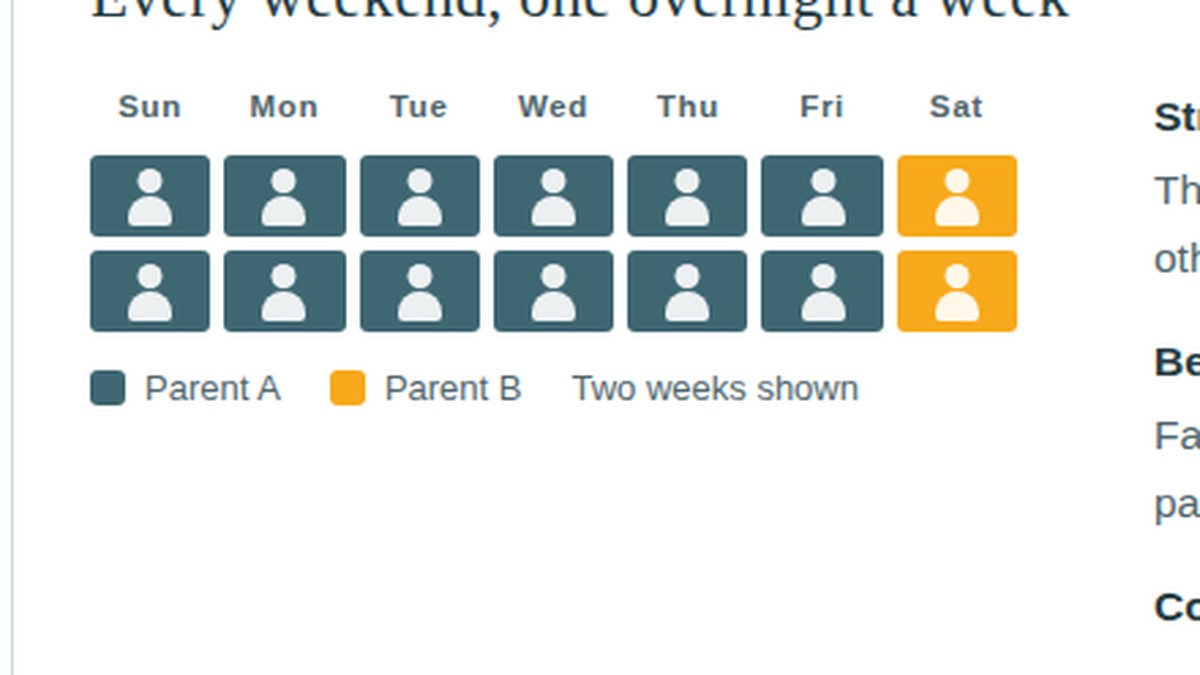
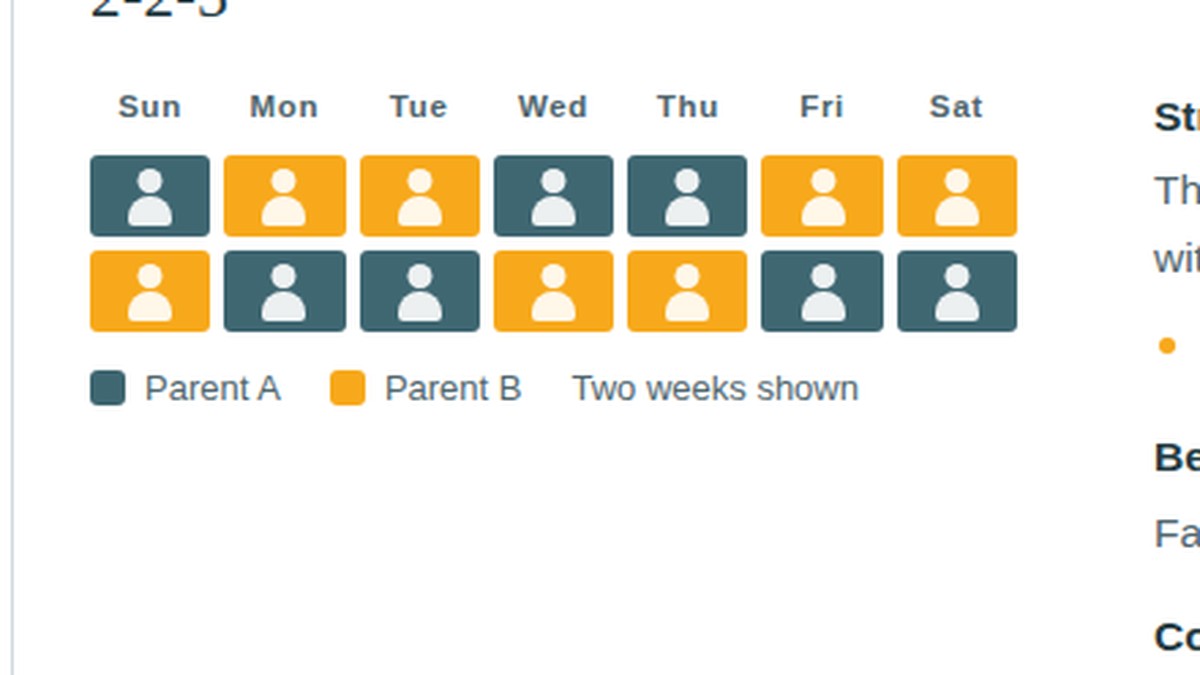
These combine messaging, a shared calendar, shared expenses and a central place for health cards and contact details. You can do the same with text messages and a shared calendar if you would rather.



None of this is about arriving with a position worked out and a lawyer behind it. It is about knowing what is actually possible, so that when a proposal is made you can tell whether it works for you.
People who have not done this often cannot say yes to a perfectly good offer, because they have no way of judging it. They are not being difficult. They simply do not have the information to decide.
That is the whole point of this step, and it is why an hour with a lawyer or a lender before the day is worth more than three hours of argument on it.

Child support is calculated from your parenting arrangement, the number of children you have, and each parent's income.
Spousal support is more complicated than child support, and there is a lot to understand, so look at the legal information resources as well.
Enforcement. Most people follow their agreements. It is a legally binding document, after all. But there is a service in BC that monitors and enforces orders and agreements once they are complete.
What is a fair buyout figure? First you have to know what you have. Our determining value page helps you account for your assets and recommends how to value each one. Once you know the values, the question becomes what you can afford.
What can I afford? Most people need some guidance on what they can financially manage and agree to in mediation. Mortgage brokers will tell you whether you can take over the mortgage and buy your spouse out. Accountants and financial divorce specialists will model what each option leaves you with.
You will find both in the professional directory your mediator sends you.
A free thirty-minute consultation costs nothing and commits you to nothing. Or take the two-minute quiz and get a roadmap written around your answers.
Book a Free Consultation Take the Quiz